Sunday, February 12, 2012

The Agony and Ecstasy Of A Bleeding Edge Bike Commute

Introduction
This is a love story and a cautionary tale of my first bike commute on my new super light folding bike: Tern Verge X20.


Background
It is safe to say I have a challenging bike commute:
  • 41 miles each way
  • 7+ miles of water to cross
  • 300+ meters of vertical to descend/climb
Given all that, I leverage regional public transportation systems all I can to ensure I don't spend 4+ hours a day commuting.

Across And Down Or Down And Across
If the Bay were a rectangle, my work would be diagonally located from my home. That means going across and down or down and across the bay.

That either means taking BART (Bay Area Rapid Transit) to San Francisco and CalTrain down the peninsula or taking BART down the East Bay and the Dumbarton Express bus across the Dumbarton Bridge. The first option was preferable because the CalTrain system on the peninsula has dedicated bike cars. No other system in the Bay Area does.

The Challenge
Therein, lies the real challenge for my bicycle commute: public transit bicycle policies. No public transit, except for CalTrain, is very keen on seeing cyclists around rush hour. BART outright bans them for each of the two rush hour periods on their transbay tunnel.

The Initial Solution
Initially, I took the alternate route to dodge BART's bike curfew for the SF transbay tunnel. I would take BART south to Union City and either cycle across or bus across the Dumbarton Bridge. 

Some Bridges Like Bikes
I was astounded and impressed to find that the Dumbarton is the one bridge from the East Bay that has a bicycle/pedestrian lane all the way across. 

This is a heartening fact in the face of the recent Bay Bridge reconstruction that includes a bicycle/pedestrian path that only goes halfway across the bay to Treasure Island (aka a bridge to nowhere). 

Anyway, for the first few weeks of April, this plan worked fine. If I got up early enough, I would BART down and cycle across the Dumbarton. The whole trip took 90 minutes but who's counting when this includes a workout (aka a reprieve from a gym visit). 

Some Buses Like Bikes
Whenever I woke up late, I would bus across (with my bike in a rack) and the whole trip took 70 minutes. 

Neither option was super fast but given that a traffic jam could make a car trip 90 minutes or more, either wasn't bad at all. Not to mention, you could fill the whole time with web surfing or reading instead of driving. 

The Reality 
Then Spring hit. It stopped raining and warmed up enough that other cyclists started having the same idea for crossing the Dumbarton. This ensured that the Dumbarton Express bus racks were always full. I tried getting to it a little early but no dice: still full. After all, there were only two racks. 

I quickly realized that the Dumbarton bus route was not a reliable option for a cyclist given the limited bike rack capacity. This produced a real bind. I didn't have time to cycle the bridge everyday and I couldn't reliably get up early enough to beat the bike crowds to the Dumbarton Express bus.

Hefty Hiatus 
Right about that time, someone asked me to carpool so I took a bike commuting hiatus. However, this felt more restrictive than all the bicycle curfews I was avoiding. No longer could I stay late at work or run errands at lunch with my bike.

Carpooling wasn't working but, by then, I had really fallen off the wagon with early rising so it felt like I couldn't turn back. Months passed. I gained 10 pounds. I had failed to replace the cycling with another form of exercise. This wouldn't do. 

The New Solution

After trying and failing to get BART to lift their rush hour bike curfew, I suddenly realized that BART's curfew excluded folding bikes. I researched those and found almost all to be sorely lacking in simplicity, sturdiness and speed. The one exception was a new generation of bikes coming from a company called Tern. 

The Tern Verge X20 seemed like a great candidate for the kind of folding bike I would need. An incredible bike by any measure: 
  • quick folding (more than I can say for many) 
  • 9.3kg (that's high end road bike territory) 
  • SRAM Red shifting (the very best, at a price to match of course)
  • 1.11 inch wide wheels (picture 23c road tire but only 20 inches in diameter, aka minimal resistance, gliders) 
This bike sounded perfect, given all my constraints:
  • terrain 
  • bike curfews 
  • rack space constraints 
  • time constraints (lighter equals much shorter commute times on bikes) 
With a folding bike, I could travel with impunity on any transit system. The bike wouldn't even need a bike rack on a bus and it would circumvent the curfews on BART.  Best of all, because it was ultralight and ultrafast, it would climb hills and cross flats almost as fast my road bike. "Woohoo! What a great time to be a bike commuter", I thought.

Waiting and Weighting


Tern is not only a brand new bike but a brand new company. Josh Hon, son of David Hon, broke away from his dad's folding bike company, you guessed it, Dahon to start his own folding bike company,Tern. The realities of starting a new company, plus some family acrimony, seemed to keep the bicycle's arrival perpetually imminent over the holidays.

Given my weight gain and total lack of will power for any other kind of exercise, I was getting desperate. After months of waiting and "weighting", the bikes finally arrived on the market and I bought the first one I found. It is here where this story really begins. The first day of bike commuting with this cutting (aka bleeding) edge commuter bike was both fantastic and horrific (no fault of the bike's btw).

The Ecstasy
The first moments were ecstasy. The bike was very stable while I reached 50kph going down 300 meters of vertical. I only added about 2 minutes to the first leg of my commute. Not bad! 

Better still, I walked onto the BART train for San Francisco with no fear of punishment even though the sign flashed "NO BIKES". The train wasn't that crowded so I didn't even bother folding it. But when the train did fill up, I had it in a pretzel in seconds. Even some of the folks on the train were impressed.

Once across the bay, I discovered I had 10 minutes to get to the CalTrain station 2km away. This was a job for the super fast Verge X20. 

Again, it performed magnificently, I found the small wheels of the folding bike much more nimble at dodging pedestrians and weaving through cars amidst the morning gridlock of downtown San Francisco. 

Likewise, the bike cruised along at a respectable 25kph on the flat long blocks. All my waiting, planning, and spending on this new cutting edge commute tool had paid off. I was leaving all the other heavy and slow commuter bikes in the dust. 

Beginners Unluck 
Then fate turned on me. It started when I arrived at the SF CalTrain station just as the doors closed on my train's gate. That cost a 15 minute delay. No matter, I thought. The bike was fast, I could still make up time on the last leg in Menlo Park. 

The Agony 
I hit the ground running in Menlo Park, I got off the train and on the bike in seconds. I charged ahead on one of Menlo Park's beautiful bike lanes to make up some lost time. Then, 100 meters out, I ran over something weird only to feel that unmistakable rumble from my rear tire. Ugh!!!!!!!! A flat.

One thing I am pretty good at is being prepared for these mishaps. The day before, I had made a special trip to the bike store for spare inner tubes for just such an occasion as this. I had also enquired about extra tires but all the shop had were unfoldables so I skipped those. I figured I would order them soon.

Not soon enough. The flat was from a cut to the sidewall. That's death for any kind of tire. So there I was: rendered a pedestrian by a tiny piece of metal with a kickass new foldable bike in tow. I went back and gave the jagged metal a good kick to vent frustration and spare someone else the same fate. 

Extraordinary Bikes Require Extraordinary Bike Stores
My fate was just getting warmed up. I've been without a tire or tube before. It's a long walk but eventually you get to a bike store and you are on your way. But this wasn't just any bike so I couldn't use just any bike store. I needed a 20" diameter, 1.1" wide, tire. That's Greek to most standard bike shops, and folding bike shops for that matter.

My mind raced:
  • Where had I seen folding bike dealers in this area. Only 2 shops out of a dozen came to mind. 
  • Is the shop open? I am late to work but it is only 9 a.m. 
  • How will I get to the shop in my bike shoes without trashing my ankles?
After making a few calls, I discovered the 2 folding bike shops were open. However, the bike was so new that none of the staff had heard of it, much less knew which parts would fix it. Still, after a LOT of explaining, I established that 1 shop had a tire I could use. Naturally, that was the most distant shop.

Googling for public transit solutions only embellished the need for a working bicycle in times like these. No buses were nearby and no bus would take me anywhere near the shop. Ironically, CalTrain got the closest to the shop so I walked back to the station, waited a quarter hour, and caught the next train.

The next hour was filled with lots of super fun walking in bike shoes and having the rare cab swiped from me by a business man while I folded my bike. But I finally got to the shop, got the tire and rode to work. Only 2.5 hours late. Woohoo! 

Epilog 

The moral of the story for me is this. Like any bleeding edge solution, be prepared to provide your own tech support. The newer the solution, the fewer resources to help when things go wrong. 

After my ordeal, I even discovered that the shop that sold me the bike had sold me the wrong size inner tubes. When you are on the bleeding edge, you are really on your own so be prepared. Internet shopping makes this easy but I jumped the gun by cycling without all the supplies.

Despite my initial lack of supplies and abundance of bad luck, I have no regrets. The ability of this type of bicycle to negotiate both the capricious bike policies of regional transit systems and the capricious streets of downtown rush hours, should ensure these bikes become increasingly popular. That should mean more stores will carry them soon and, in turn, mean I will have less far to walk for parts. 

Regardless, I now stock a new tube and tire on my back for this bike as I do for all my full sized bikes. I gambled and lost this time but I won't again, especially with such a wonderful new type of bike.

Wednesday, October 12, 2011

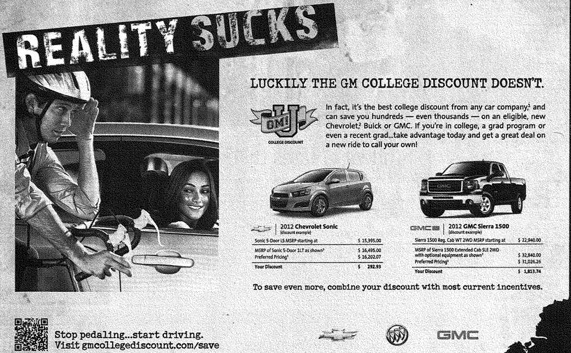
GM's Ad: Correcting The Real Offense

UPDATE: Giant Bicycles post an ad that responds to the GM ad. Details on Grist. The ad is displayed below the GM ad here.

While monitoring the "sound and fury" surrounding the recent General Motor's cyclist-bashing ad posted by BikePortland.org, it was heartening to see the downpour of support for cycling and to see it actually affect GM's plans.

Nevertheless, this ad is just the tip of the iceberg. There's been a media blitz of bicycle-bashing for years (this slate.com article talks all about it). Bicycles and cyclists are frequent symbols of emasculation and failure in media. Just in the last 5 years, there's Brad Pitt in Burn After Reading, Steve Carell in 40 Year Old Virgin, Will Ferrell in Everything Must Go and Ben Stiller in Greenberg. Is it GM we're mad at or Madison Avenue and Hollywood?

Furthermore, it seems silly to be shocked that car ads would use sex to promote cars and disparage other modes of transport. Doubly so, given that we just bailed out this particular company from financial ruin and told them to go and compete as best they can. These are the guys who took private  jets to D.C. to tell us they were broke. We gave them money anyway. Now we are shocked that these guys don't "get it"?

The real offense is that we somehow elected government representatives that chose to keep this company alive instead of promoting multi-modal transportation. Had we not done that, we would be reaping the benefits of job-creating infrastructure projects and economy-stimulating traffic from pedestrians and cyclists. Instead we're spending our time shouting down tasteless ads for which we paid and ultimately voted while dodging more cars.

Given this industry's track record (GM's in particular), it is doubtful GM learned anything from this. While they are issuing an apology to us, it would not be surprising if they try to get a return on their ad investment by simply retrofitting this ad campaign for some place else in the world where folks don't squawk so much. Ultimately, GM has been and will continue to be an obsolete organization ruthlessly preserving itself and perpetuating an outdated, unsustainable, vision of transportation.

Like Steve Jobs once said, "death is nature's change agent". This ad is a perfect example of what we get when we don't let nature take its course.

Successfully shouting down this stupidity is definitely a sign of progress but it won't really change anything. Only starving the old oil and car lobbies of money will do that. Ironically, that will be tough in the next election given that our next president will either be the guy that saved this miserable company and wants to import oil from Canadian tar sands or a guy from Michigan. Regardless, we can still vote with our feet, our pedals, and our media choices.

Saturday, October 1, 2011

2011 Cyclists Fatalities Already Alarming. What Can Be Done?

Fatality Spikes
The last few weeks have felt like an epidemic to many cyclists in Los Angeles. BikingInLA reported 52 cyclist fatalities as of September 24 and there have been more since then.

Likewise, Seattle q13fox.com reported 10 fatalities so far this year. Three of those have occurred since July, according to StreetsBlog.

Spikes Not Pervasive
The spike hasn't been seen everywhere. In the San Francisco Bay Area, various news agencies have reported less than 10 for the year. But that's down from 15 in 2009, according to this Bike Accident Tracker. In New York City, Gothamist.com reported the city's 10th fatality on September 4. But that's down from 12 fatalities in NYC in 2009, according to stats cited in the Village Voice. Obviously, the year is not over yet but these numbers are relatively flat given the growth in cycling's popularity and compared to Seattle and LA.


Among improved instrastructure, law enforcement, and training, only law enforcement is quick to implement.
So, as many are asking, "what is going on?" And how do we prevent this? Despite an incredible, perhaps cynical, lack of data collected by our governments on cycling fatalities, we know from experience where solutions lie: improved infrastructure, law enforcement, and training. More detail can surely be revealed about the cause of the spikes this year but simply reviewing some of the cases shows these 3 components would help a lot.

Causes
In Seattle, Seattlebikeblog and others have already identified incomplete and/or poorly designed bicycle infrastructure as a cause. In LA, a common cause is hit and runs by drivers. In New York, one cause was a cyclist going the wrong way down a street. Studies to precisely identify the root causes of all these incidents take time. What can be done to prevent more people from dying right now?

Short Term Solutions: Few
Among improved instrastructure, law enforcement, and training, only law enforcement is quick to implement. New bike lanes or training programs won't save the cyclist who dies tomorrow but better law enforcement might.

Law Enforcement
However, better law enforcement requires the right laws to be in place and resources, a.k.a. dollars, to take action. As of this writing, Governor of California, Jerry Brown, just vetoed cycling advocate's third attempt to pass a "3 feet rule": SB910. Even more challenging, he did so at the urging of the CHP.

Operation Safe Passage
Even so, law enforcement does act on similar issues. Right now, a collaboration of police agencies and the CHP are implementing "Operation Safe Passage", a program to enforce "zero tolerance" of hazardous driving around schools. This operation was planned in advanced but it was able to start just a day after a 6 year old pedestrian was killed.

Since cyclists are not concentrated in one area like a school, such a program is tougher to scope to address cycling risks. Nevertheless, something similar could be designed and implemented quickly if the political will exists.

Sources of Political Will
So where to get political will? The three classic sources are money, publicity, and pooling support with other groups. All are already at work for cycling in various degrees. With immediacy being the current goal, only one stands out.

Money Can't Buy Us Love
In the current system, money could very possibly buy us love but can we afford it and do we want to perpetuate this perverted system? Regardless, using money to lobby for cycling has obvious drawbacks for the cycling community. Bicycles alone do not represent the dollars that cars and other industries do.

Bicycle Revenue Connection Still Fuzzy
Many studies show bike-friendly communities do generate lots of revenue but the association with all those dollars is not as direct. Any bicycle lobby will find it tough to compete until it consolidates financial support from all the ancillary businesses that benefit from bike-friendly streets. And that won't happen until more bike-friendly communities are created which, ironically, requires more lobbying.

Publicity
So if money can't buy cyclists love (at least for now), what about publicity? These tragedies have produced that. Seattle's mayor plans to hold a bicycle safety summit in response to all the recent cycling fatalities. However, summits don't necessarily lead to a solution as Los Angeles knows all too well. Their mayor held a bike summit last year. Despite a lot of great cycling developments in LA since then, the deaths keep coming.

Even Alan Dershowitz Can't Get Justice
In order for such events to be effective, they need the focus of the greater majority and not just the cyclist community. As Alan Dershowitz's experience shows, as he tries to identify all those involved in his sister-in-law's death, going it alone to get justice is tough. If one of the foremost attorney's in the country can't get justice, it is clear other forces need to be employed.

With a high enough profile, Mr. Dershowitz would get a cooperative DA and Los Angeles could immediately find/raise money for officers to clamp down on texters, speeders, and drunks causing the hit and runs. Without that larger audience, no summit or anything else will generate enough political will to do much more than is already being done.

Publicity Possibilities
AIDS Awareness
Nevertheless, getting that focus is not impossible. Good lessons for how to do this lie in how AIDS awareness was expanded beyond the minorities that first experienced the disease. Again, the problem is time: expanding AIDS awareness took decades.

Occupy Wall Street
So what can be done in the short term? The group Occupy Wall Street is showing one way right now: a protest. However, this is having limited success because their message is not clear and they are not appealing to the majority's self interest. This lack of focus may be intentional but it still leaves the mainstream confused and apathetic.

Overcoming Distraction
If you want a distracted person's attention, you can't waste time telling them what you are against, you've got to tell them what you are for, what you want and why they should care, and do this instantly. That's more rally or vigil than protest.

Celebrity Association
One way to instantly get people to care is to simply get familiar faces associated with your event. The Occupy Wall Street protest really took off when Michael Moore and Susan Sarandon showed up: shallow but true. The other way to engage is to illustrate the magnitude of the loss, again instantly, e.g. the AIDS quilt.

Rally For A Common Cause
This is what cyclists can do in the short term. Hold a vigil or rally for those we've lost with something visual and large of which distracted passers by or TV viewers will take note, and with a clear way for empathetic people to respond. With a high enough profile to the event, it is possible to obtain substantial new resources quickly.

Pooling Support
Pooling support with groups sharing common interests is yet another way to build support. In this case, the obvious group is pedestrians. Many groups already combine cyclists and pedestrians for this reason. This group is as financially challenged as the cyclist group, so joint efforts may not have a huge impact in lobbying any legislature. Nevertheless, it could potentially have a huge impact on any rally. Like the cycling community, pedestrians suffer greatly from cars. Many people do not cycle but almost everyone is, or has been, a pedestrian at some point. Holding a combined rally would appeal to the majority's self interest.

Long Term Solutions
A lot of the long term work is already being done. The goal is obviously to do it more effectively and swiftly. One well-known key to that is to fill the data gap. Enact legislation that forces officers and other officials to collect detailed data on bicycle traffic volume and accidents.

Data gives the few intrepid politicians out there the foothold they need to take unpopular or unprecedented action. Unfortunately, many industries like the oil, tobacco, and auto industries know this so they sometimes lobby against collecting the data.  Nevertheless, from good data can come good infrastructure, training, as well as the good laws and enforcement.

After supporting any rally in support of better law enforcement, my focus is going to be on legislature that improves data collection on all cycling activity including these accidents. At best, we need to know as much detail as possible about the cause of these tragedies. At least, we need to concretely document for the powers that be how many more of us are now out there.

None of this will bring those victims back but for those of us that feel we must do something, these are constructive and tenable.