When I asked why this does not normally run during winter, I was told it was because demand was too low. They didn't have a large enough volume of riders to justify regular intervals up to the mountain. Consequently, the few trips that were made were very expensive. I immediately thought of one obvious source for a large volume of riders: the patrons of the 2010 Olympic Winter Games! Given these shots of the rail stations beauty and proximity to Whistler mountain, and all the aggravation reported from all those that had to drive to the Olympics, I find it hard to believe that people would not have chosen the train in droves. It is truly tragic that VANOC did not embrace this transportation option.
Monday, February 22, 2010
Tweet

I found the trail I had heard about connecting Creekside to Whistler and it is fabulous. Today I pedaled from Creekside to Whistler without seeing a single moving car. The trail winds past the frozen Nita Lake and the beautiful Nita Lake Lodge (both seen here). And it is not just a single trail. It is an entire network of trails. What a fabulous resource in winter time for getting around.
This trail is absolutely beautiful and peaceful. So peaceful, in fact, that even on a crisp shady afternoon the trail was full of cyclists, runners (some of them in Olympic team uniforms), dog walkers, even readers. You can see the woman sitting on the rock reading as she overlooks the frozen Nita Lake. What a beautiful site. She liked this photo so much she had me take one with her camera.
I found this guy actually riding on the lake. I was tempted to join him but decided against without more detailed knowledge of the lake's freezover patterns.
This radically changes my perception of the Whistler winter cycling experience. It is not a mixed bag at all. It is awesome. Perhaps the locals I talked to were not familiar with the awesome set of trails available for getting around Whistler with NO exposure to the noise and danger of fast moving cars. Perhaps normal winter weather produces too much snow to adequately plow these trails. Regardless, someone is plowing the trails successfully now and some locals obviously know these trails are here. I found this guy running a very telling errand in a ski town.


Pedaling back from Whistler along the newly found bike trail, I also found that there is indeed a train to Whistler: the Whistler Mountaineer. It even stops right behind the Nita Lake Lodge which is a short walk across the highway from the Creekside Gondola. What a dream of a commute to Whistler! Apparently, this only runs in summer for the general public but a chartered version of it just happened to be stopped behind the Nita Lake Lodge when I cycled past on the bike trail. Unbelievable that this was not a highly promoted option for getting to the 2010 Olympic Winter Games!
When I asked why this does not normally run during winter, I was told it was because demand was too low. They didn't have a large enough volume of riders to justify regular intervals up to the mountain. Consequently, the few trips that were made were very expensive. I immediately thought of one obvious source for a large volume of riders: the patrons of the 2010 Olympic Winter Games! Given these shots of the rail stations beauty and proximity to Whistler mountain, and all the aggravation reported from all those that had to drive to the Olympics, I find it hard to believe that people would not have chosen the train in droves. It is truly tragic that VANOC did not embrace this transportation option.
If the incredible convenience and beauty of this train stop were not attractive enough, how about this? As I pedaled away from the Nita Lake Lodge, who do I find on the bike trail but Steve Podborski (one of the greatest ski racers of all time, a member of the "crazy canucks", and currently a commentator for NBC Sports during the 2010 Olympic Winter Games). He was actually walking to get on the train. Apparently, the province of Alberta had chartered it for the games and he was one of their guests. So this option is available but to an exclusive few. Steve is certainly worthy of such a privilege but I still wish VANOC had pushed to extend it to many more and possibly sidestepped a lot of controversy of the highway upgrades. Oh well! All of this resulted in me bumping into one of my idols. For that I am incredibly grateful. As I rode off, he said "ride safe". I'll ride as safely as you ski, Steve :).
Cycling the 2010 Olympic Winter Games: Part II
When I asked why this does not normally run during winter, I was told it was because demand was too low. They didn't have a large enough volume of riders to justify regular intervals up to the mountain. Consequently, the few trips that were made were very expensive. I immediately thought of one obvious source for a large volume of riders: the patrons of the 2010 Olympic Winter Games! Given these shots of the rail stations beauty and proximity to Whistler mountain, and all the aggravation reported from all those that had to drive to the Olympics, I find it hard to believe that people would not have chosen the train in droves. It is truly tragic that VANOC did not embrace this transportation option.
Saturday, February 20, 2010
Tweet
Met these fine folks this evening while strolling through the Whistler Olympic Village. The WHOLE family had arrived at the village by bike, complete with dog. The dog runs alongside the bikes.
Apparently, these folks find cycling to work during a typical Whistler winter a tad much but using bikes on a beautiful and unseasonably warm winter day to avoid all the traffic hassles and enjoy the day is not a problem and such a pleasure. That is too cool.
Family Travels To Whistler Olympic Village By Bike
Apparently, these folks find cycling to work during a typical Whistler winter a tad much but using bikes on a beautiful and unseasonably warm winter day to avoid all the traffic hassles and enjoy the day is not a problem and such a pleasure. That is too cool.
Thursday, February 18, 2010
Tweet
See also Part II and Part III.
When I decided to bring my bike to the 2010 Olympic Winter Games, a lot of folks questioned the idea, including a lot of locals. Everyone cited the obvious: winter weather. The locals also cited the fact that the roads between key points in Whistler were not particularly bike-friendly. The bike lanes are in place but some parts just run along a very busy highway that includes the traffic from a pretty good bus service. Despite all this, I brought my bike. To be honest, it has been a mixed bag. I found both great and lousy bike lanes since being here. (See Part II of this story for more great trail photos.)

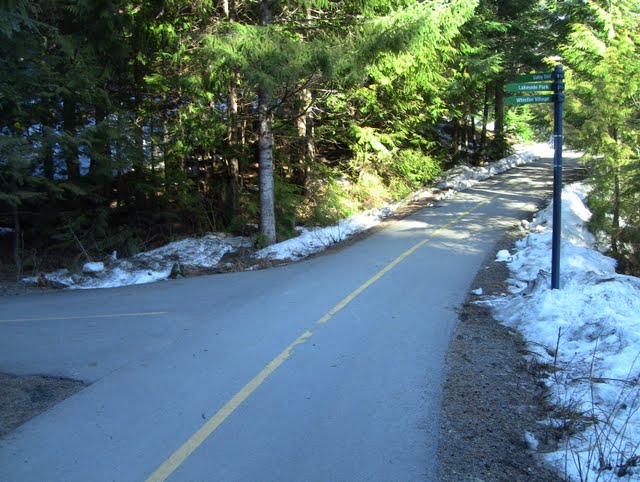
Some, like this one, are great. Passing through lush green forests or quiet neighborhoods, they leave one feeling perfectly serene and secure. The breathtaking backdrop of the Whistler mountains puts the experience over the top. A simple ride to the barber and grocery store was a delight and a decent workout, even if I did have to share the path with the occasionally knuckledragger.
Sadly or happily (depending on your view of climate change) the weather has not been a factor. Although the weather has been unbelievably warm, the first week did manage to throw a few cold rains at me. That did make the ride home from the barber a bit hectic and messy when taking the highway bike lanes. However, the worst of that was the car traffic, not the rain. I'm told there's a dedicated bike trail, totally off the highway, between Creekside and Whistler. I'm determined to find it before I leave. (See Part II of this story to see what I found.)
Though nice, the mild weather, is kind of a bummer, at least, for me personally. First, I really wanted to see how snow cycling feels. Second, it is just plain disconcerting to have weeks of spring-like conditions in the middle of February. One wonders if we really are witnessing climate change at the Olympics which in turn makes one wonder how much longer a winter Olympics will even be possible except at the highest latitudes. Vancouver is already pretty far north. Are the games going to have to move to the arctic circle in my life time?
What compounds these concerns is seeing how ungreen winter Olympic events are. This is the greenest Olympics ever. All the disposable cups, cartons, and silverware are compostable. Some of my volunteer uniform is made from bamboo (super soft too) because it is far less resource-intensive than cotton. A lot of the new buildings are self-sustaining with regard to water and power.

Nevertheless, there is still the jet fuel for helicopters, the diesel for snowcats, the gasoline for snowmobiles, the water for snowmaking machines, the plastic for all the decorations, the merchandising, the temporary construction, etc., etc. All this is still part of the games. There's no question that events like these will always be resource-intensive but there's obviously a lot more to be done to improve the resource footprint for an event like this. The spring weather in February has been a constant reminder that more had better be done soon.
British Columbia and VANOC missed a great opportunity to discourage car use by upgrading the Sea to Sky highway rather than upgrading the rail system. The Alps are littered with ski resorts where the train station stops just steps from the base of lifts. I've personally seen people getting on the train in their ski boots in downtown Munich. They can do that because the train system there offers virtual door to door access to numerous ski resorts. Imagine all the traffic jams that occur during snow storms replaced by train loads of people drinking hot cocoa (or even something stronger) during their relaxed journey from town to the slopes. Now stop imagining it because British Columbia and VANOC missed a great opportunity to embellish the European village atmosphere they've developed in Whistler by perpetuating the North American emphasis on the car.
Nevertheless, train systems beg lots of other questions that ultimately reduce to the larger question of what type of transport will dominate in a given society. In order for a rail system to work, it has to go virtually everywhere. Vancouver has no pervasive subway system or light rail so how would it deliver people in large numbers to the Sea to Sky rail system? How would people get to the few subway stations? By car? If so, then that would defeat a lot of the purpose.
Still, even half-measures were passed over: like promoting bus use rather than car use. The world famous ski town Zermatt banned cars years ago. It is only accessible by train but there's no reason you couldn't introduce bus-only access to Whistler to create a similar car-free ambience in the village and remove the need for a highway upgrade by virtually compressing the added traffic volume into buses.
If that's still too untenable, how about just installing bike-racks on buses or having bike-dedicated buses to and around Whistler so that those that want to use bikes as transport around Whistler can do. The roads to and around Whistler are pretty flat relative to other mountain resorts. Riding a bike with a little trailer that holds skis and snowboards onto a bike-dedicated train or bus would have been a fun and efficient way to get to and around the mountains.
If nothing else, I wish VANOC (Vancouver Olympic Committee) would have refrained from hauling Wayne Gretzky (the final torch bearer) in an SUV to light the Olympic cauldron. This is traditionally a runners task so it seems particularly gratuitous, untraditional, and antithetical to a green event to put the would-be runner in an SUV. Anything but that. Why not a bike? What a great symbolic gesture that would have been to have "the great one" hop on a bike (Canadian-made even) to travel to the torch in a reasonable amount of time.
Regardless, what has felt good is fulfilling the planbike mission to send a message with direct action to all the guests of the Olympic games that bikes work anywhere and anytime and, with the proper scale of adoption, could be an important component to keeping the world inhabitable and some snow on the mountains. The unseasonably warm weather, for me, makes this point even more important to make. It was also heartening to find out I wasn't alone. Found this gal, a fellow volunteer in her blue smurf suit, out at 4:30 a.m. on her way to work. Cycle on girl!
The ride to Whistler is so beautiful, it is a shame that anyone has to keep their eyes on the road during the journey. Nevertheless, I'm enjoying the games, enjoying the scenery, and enjoying the bike.
See Part II of this story.
Cycling the 2010 Olympic Winter Games: Part I
When I decided to bring my bike to the 2010 Olympic Winter Games, a lot of folks questioned the idea, including a lot of locals. Everyone cited the obvious: winter weather. The locals also cited the fact that the roads between key points in Whistler were not particularly bike-friendly. The bike lanes are in place but some parts just run along a very busy highway that includes the traffic from a pretty good bus service. Despite all this, I brought my bike. To be honest, it has been a mixed bag. I found both great and lousy bike lanes since being here. (See Part II of this story for more great trail photos.)
Though nice, the mild weather, is kind of a bummer, at least, for me personally. First, I really wanted to see how snow cycling feels. Second, it is just plain disconcerting to have weeks of spring-like conditions in the middle of February. One wonders if we really are witnessing climate change at the Olympics which in turn makes one wonder how much longer a winter Olympics will even be possible except at the highest latitudes. Vancouver is already pretty far north. Are the games going to have to move to the arctic circle in my life time?
What compounds these concerns is seeing how ungreen winter Olympic events are. This is the greenest Olympics ever. All the disposable cups, cartons, and silverware are compostable. Some of my volunteer uniform is made from bamboo (super soft too) because it is far less resource-intensive than cotton. A lot of the new buildings are self-sustaining with regard to water and power.
British Columbia and VANOC missed a great opportunity to discourage car use by upgrading the Sea to Sky highway rather than upgrading the rail system. |
Nevertheless, train systems beg lots of other questions that ultimately reduce to the larger question of what type of transport will dominate in a given society. In order for a rail system to work, it has to go virtually everywhere. Vancouver has no pervasive subway system or light rail so how would it deliver people in large numbers to the Sea to Sky rail system? How would people get to the few subway stations? By car? If so, then that would defeat a lot of the purpose.
Still, even half-measures were passed over: like promoting bus use rather than car use. The world famous ski town Zermatt banned cars years ago. It is only accessible by train but there's no reason you couldn't introduce bus-only access to Whistler to create a similar car-free ambience in the village and remove the need for a highway upgrade by virtually compressing the added traffic volume into buses.If that's still too untenable, how about just installing bike-racks on buses or having bike-dedicated buses to and around Whistler so that those that want to use bikes as transport around Whistler can do. The roads to and around Whistler are pretty flat relative to other mountain resorts. Riding a bike with a little trailer that holds skis and snowboards onto a bike-dedicated train or bus would have been a fun and efficient way to get to and around the mountains.
If nothing else, I wish VANOC (Vancouver Olympic Committee) would have refrained from hauling Wayne Gretzky (the final torch bearer) in an SUV to light the Olympic cauldron. This is traditionally a runners task so it seems particularly gratuitous, untraditional, and antithetical to a green event to put the would-be runner in an SUV. Anything but that. Why not a bike? What a great symbolic gesture that would have been to have "the great one" hop on a bike (Canadian-made even) to travel to the torch in a reasonable amount of time. See Part II of this story.
Labels:
bike commute,
bike lane,
bus,
commuting,
olympics,
train,
travel,
vancouver,
velotourist,
whistler
Subscribe to:
Posts (Atom)