Saturday, March 31, 2012

Cycling Washington D.C.: Getting There

Background
In 1972 my dad and I toured Washington D.C. by bicycle. That produced fond memories. News in recent years from D.C. about Gabe Klein's appointment to DDOT, the resulting new Capital Bikeshare program, and miles of new bike lanes, made we want to cycle D.C. again. Cycling during the 2012 National Bike Summit in Washington D.C., made for a nice 30 year reunion between my bike and the nation's capital.

Introduction
More D.C. photos:
What follows are a lot of pictures and a few reflections on this experience. There were so many that I've divided them into separate posts. This is the first one. I just call it "getting there".


Getting There
Cycling to D.C. from California might be nice some day when I have more time to spare but since that day has not yet arrived, I had to fly. That said, the whole point was to ride the city when I got there. Where to get a bike?

Rent or Bring?
Although Capital Bikeshare is a great program for getting around the city proper, I had longer rides planned. A fitted road bike would be more suited to the task.

Although I have rented, and could rent, a proper road bike, I am also tall and oddly proportioned. Most rentals target the average-sized person. I knew from painful experience that I needed a bike that fit really well or I would be laid up with backaches instead of out enjoying my stay. Consequently, I decided to bring my own bike.

Nevertheless, if you are in that sweet spot of 5 feet 2 inches to 6 feet 2 inches, chances are there is a rental bike available no matter what quality level you require.


Flying With Bikes
Full-Size Bikes
Flying with full-size bikes can be an expensive proposition.  For the Olympics, United charged me $100 each way. Granted, that was for a 3 foot by 4 foot rolling bike box but it wasn't as heavy as many regular suitcases and other airlines have charged far less or nothing at all for the same case  (e.g. Southwest and JetBlue).

Folding Bikes
This time I hoped to avoid such expenditures by bringing my folding bike in a regular suitcase. The folding bike suitcase was large but not so large that it could not to be treated like regular luggage, or so I thought.

Unfortunately, I answered honestly when I was asked what was in the suitcase. Once the word "bike" was mentioned, I was kicked out of the normal luggage line and placed with the Australian surfer checking in his surfboard. He got stung for $100. I paid $125 because the ticketing staff suddenly realized that they hadn't been charging the "normal luggage fee" on top of the oversized luggage fee.

Despite the fact that my suitcase was not overweight and could easily fit on the normal conveyor belt, I was assured my bike case could not be treated as regular luggage. Consequently, it was a bitter irony to see my suitcase come out of the normal conveyor belt when it arrived in D.C., i.e. not the oversized luggage door.

My advice: don't fly United with any bike. Other airlines are way more accommodating to bikes. As for folding, make sure the suitcase really is standard size. In my case, that means I have to breakdown my Tern Verge X20 a little more than I hoped. For serious compactness, the Brompton seems good. However, no folding yet matches my Tern for serious long rides.

D.C. Metro: Nice
Ronald Reagan Airport
Thanks to the newish Ronald Reagan Washington Airport, which is surprisingly central and well-connected to D.C.s metro, getting to my hotel downtown took virtually the same amount of time as a cab at rush hour.

The D.C. metro was great. Maybe I was just lucky but I never waited long for a train, not even when I got lost and had to reverse direction. It was also relatively clean and the stations look pretty cool.

I Have Arrived
The first thing I saw as I exited my metro station was a separated bike lane: a welcoming sign. Unfortunately, I couldn't ride it just yet. My bike was packed up in its suitcase.

Note to folding bike makers: build a bike case that you can tow behind your bike so you can extract the bike and ride immediately upon arrival. I've seen a few of these but you have to assemble the wheels. The ideal would be something done in seconds at the airport or metro station.

More D.C. photos: 


Sunday, February 12, 2012

The Agony and Ecstasy Of A Bleeding Edge Bike Commute

Introduction
This is a love story and a cautionary tale of my first bike commute on my new super light folding bike: Tern Verge X20.


Background
It is safe to say I have a challenging bike commute:
  • 41 miles each way
  • 7+ miles of water to cross
  • 300+ meters of vertical to descend/climb
Given all that, I leverage regional public transportation systems all I can to ensure I don't spend 4+ hours a day commuting.

Across And Down Or Down And Across
If the Bay were a rectangle, my work would be diagonally located from my home. That means going across and down or down and across the bay.

That either means taking BART (Bay Area Rapid Transit) to San Francisco and CalTrain down the peninsula or taking BART down the East Bay and the Dumbarton Express bus across the Dumbarton Bridge. The first option was preferable because the CalTrain system on the peninsula has dedicated bike cars. No other system in the Bay Area does.

The Challenge
Therein, lies the real challenge for my bicycle commute: public transit bicycle policies. No public transit, except for CalTrain, is very keen on seeing cyclists around rush hour. BART outright bans them for each of the two rush hour periods on their transbay tunnel.

The Initial Solution
Initially, I took the alternate route to dodge BART's bike curfew for the SF transbay tunnel. I would take BART south to Union City and either cycle across or bus across the Dumbarton Bridge. 

Some Bridges Like Bikes
I was astounded and impressed to find that the Dumbarton is the one bridge from the East Bay that has a bicycle/pedestrian lane all the way across. 

This is a heartening fact in the face of the recent Bay Bridge reconstruction that includes a bicycle/pedestrian path that only goes halfway across the bay to Treasure Island (aka a bridge to nowhere). 

Anyway, for the first few weeks of April, this plan worked fine. If I got up early enough, I would BART down and cycle across the Dumbarton. The whole trip took 90 minutes but who's counting when this includes a workout (aka a reprieve from a gym visit). 

Some Buses Like Bikes
Whenever I woke up late, I would bus across (with my bike in a rack) and the whole trip took 70 minutes. 

Neither option was super fast but given that a traffic jam could make a car trip 90 minutes or more, either wasn't bad at all. Not to mention, you could fill the whole time with web surfing or reading instead of driving. 

The Reality 
Then Spring hit. It stopped raining and warmed up enough that other cyclists started having the same idea for crossing the Dumbarton. This ensured that the Dumbarton Express bus racks were always full. I tried getting to it a little early but no dice: still full. After all, there were only two racks. 

I quickly realized that the Dumbarton bus route was not a reliable option for a cyclist given the limited bike rack capacity. This produced a real bind. I didn't have time to cycle the bridge everyday and I couldn't reliably get up early enough to beat the bike crowds to the Dumbarton Express bus.

Hefty Hiatus 
Right about that time, someone asked me to carpool so I took a bike commuting hiatus. However, this felt more restrictive than all the bicycle curfews I was avoiding. No longer could I stay late at work or run errands at lunch with my bike.

Carpooling wasn't working but, by then, I had really fallen off the wagon with early rising so it felt like I couldn't turn back. Months passed. I gained 10 pounds. I had failed to replace the cycling with another form of exercise. This wouldn't do. 

The New Solution

After trying and failing to get BART to lift their rush hour bike curfew, I suddenly realized that BART's curfew excluded folding bikes. I researched those and found almost all to be sorely lacking in simplicity, sturdiness and speed. The one exception was a new generation of bikes coming from a company called Tern. 

The Tern Verge X20 seemed like a great candidate for the kind of folding bike I would need. An incredible bike by any measure: 
  • quick folding (more than I can say for many) 
  • 9.3kg (that's high end road bike territory) 
  • SRAM Red shifting (the very best, at a price to match of course)
  • 1.11 inch wide wheels (picture 23c road tire but only 20 inches in diameter, aka minimal resistance, gliders) 
This bike sounded perfect, given all my constraints:
  • terrain 
  • bike curfews 
  • rack space constraints 
  • time constraints (lighter equals much shorter commute times on bikes) 
With a folding bike, I could travel with impunity on any transit system. The bike wouldn't even need a bike rack on a bus and it would circumvent the curfews on BART.  Best of all, because it was ultralight and ultrafast, it would climb hills and cross flats almost as fast my road bike. "Woohoo! What a great time to be a bike commuter", I thought.

Waiting and Weighting


Tern is not only a brand new bike but a brand new company. Josh Hon, son of David Hon, broke away from his dad's folding bike company, you guessed it, Dahon to start his own folding bike company,Tern. The realities of starting a new company, plus some family acrimony, seemed to keep the bicycle's arrival perpetually imminent over the holidays.

Given my weight gain and total lack of will power for any other kind of exercise, I was getting desperate. After months of waiting and "weighting", the bikes finally arrived on the market and I bought the first one I found. It is here where this story really begins. The first day of bike commuting with this cutting (aka bleeding) edge commuter bike was both fantastic and horrific (no fault of the bike's btw).

The Ecstasy
The first moments were ecstasy. The bike was very stable while I reached 50kph going down 300 meters of vertical. I only added about 2 minutes to the first leg of my commute. Not bad! 

Better still, I walked onto the BART train for San Francisco with no fear of punishment even though the sign flashed "NO BIKES". The train wasn't that crowded so I didn't even bother folding it. But when the train did fill up, I had it in a pretzel in seconds. Even some of the folks on the train were impressed.

Once across the bay, I discovered I had 10 minutes to get to the CalTrain station 2km away. This was a job for the super fast Verge X20. 

Again, it performed magnificently, I found the small wheels of the folding bike much more nimble at dodging pedestrians and weaving through cars amidst the morning gridlock of downtown San Francisco. 

Likewise, the bike cruised along at a respectable 25kph on the flat long blocks. All my waiting, planning, and spending on this new cutting edge commute tool had paid off. I was leaving all the other heavy and slow commuter bikes in the dust. 

Beginners Unluck 
Then fate turned on me. It started when I arrived at the SF CalTrain station just as the doors closed on my train's gate. That cost a 15 minute delay. No matter, I thought. The bike was fast, I could still make up time on the last leg in Menlo Park. 

The Agony 
I hit the ground running in Menlo Park, I got off the train and on the bike in seconds. I charged ahead on one of Menlo Park's beautiful bike lanes to make up some lost time. Then, 100 meters out, I ran over something weird only to feel that unmistakable rumble from my rear tire. Ugh!!!!!!!! A flat.

One thing I am pretty good at is being prepared for these mishaps. The day before, I had made a special trip to the bike store for spare inner tubes for just such an occasion as this. I had also enquired about extra tires but all the shop had were unfoldables so I skipped those. I figured I would order them soon.

Not soon enough. The flat was from a cut to the sidewall. That's death for any kind of tire. So there I was: rendered a pedestrian by a tiny piece of metal with a kickass new foldable bike in tow. I went back and gave the jagged metal a good kick to vent frustration and spare someone else the same fate. 

Extraordinary Bikes Require Extraordinary Bike Stores
My fate was just getting warmed up. I've been without a tire or tube before. It's a long walk but eventually you get to a bike store and you are on your way. But this wasn't just any bike so I couldn't use just any bike store. I needed a 20" diameter, 1.1" wide, tire. That's Greek to most standard bike shops, and folding bike shops for that matter.

My mind raced:
  • Where had I seen folding bike dealers in this area. Only 2 shops out of a dozen came to mind. 
  • Is the shop open? I am late to work but it is only 9 a.m. 
  • How will I get to the shop in my bike shoes without trashing my ankles?
After making a few calls, I discovered the 2 folding bike shops were open. However, the bike was so new that none of the staff had heard of it, much less knew which parts would fix it. Still, after a LOT of explaining, I established that 1 shop had a tire I could use. Naturally, that was the most distant shop.

Googling for public transit solutions only embellished the need for a working bicycle in times like these. No buses were nearby and no bus would take me anywhere near the shop. Ironically, CalTrain got the closest to the shop so I walked back to the station, waited a quarter hour, and caught the next train.

The next hour was filled with lots of super fun walking in bike shoes and having the rare cab swiped from me by a business man while I folded my bike. But I finally got to the shop, got the tire and rode to work. Only 2.5 hours late. Woohoo! 

Epilog 

The moral of the story for me is this. Like any bleeding edge solution, be prepared to provide your own tech support. The newer the solution, the fewer resources to help when things go wrong. 

After my ordeal, I even discovered that the shop that sold me the bike had sold me the wrong size inner tubes. When you are on the bleeding edge, you are really on your own so be prepared. Internet shopping makes this easy but I jumped the gun by cycling without all the supplies.

Despite my initial lack of supplies and abundance of bad luck, I have no regrets. The ability of this type of bicycle to negotiate both the capricious bike policies of regional transit systems and the capricious streets of downtown rush hours, should ensure these bikes become increasingly popular. That should mean more stores will carry them soon and, in turn, mean I will have less far to walk for parts. 

Regardless, I now stock a new tube and tire on my back for this bike as I do for all my full sized bikes. I gambled and lost this time but I won't again, especially with such a wonderful new type of bike.

Wednesday, October 12, 2011

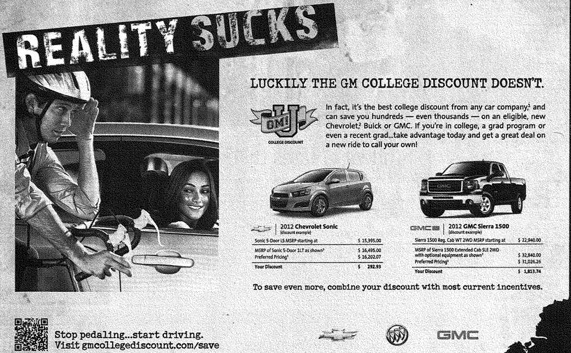
GM's Ad: Correcting The Real Offense

UPDATE: Giant Bicycles post an ad that responds to the GM ad. Details on Grist. The ad is displayed below the GM ad here.

While monitoring the "sound and fury" surrounding the recent General Motor's cyclist-bashing ad posted by BikePortland.org, it was heartening to see the downpour of support for cycling and to see it actually affect GM's plans.

Nevertheless, this ad is just the tip of the iceberg. There's been a media blitz of bicycle-bashing for years (this slate.com article talks all about it). Bicycles and cyclists are frequent symbols of emasculation and failure in media. Just in the last 5 years, there's Brad Pitt in Burn After Reading, Steve Carell in 40 Year Old Virgin, Will Ferrell in Everything Must Go and Ben Stiller in Greenberg. Is it GM we're mad at or Madison Avenue and Hollywood?

Furthermore, it seems silly to be shocked that car ads would use sex to promote cars and disparage other modes of transport. Doubly so, given that we just bailed out this particular company from financial ruin and told them to go and compete as best they can. These are the guys who took private  jets to D.C. to tell us they were broke. We gave them money anyway. Now we are shocked that these guys don't "get it"?

The real offense is that we somehow elected government representatives that chose to keep this company alive instead of promoting multi-modal transportation. Had we not done that, we would be reaping the benefits of job-creating infrastructure projects and economy-stimulating traffic from pedestrians and cyclists. Instead we're spending our time shouting down tasteless ads for which we paid and ultimately voted while dodging more cars.

Given this industry's track record (GM's in particular), it is doubtful GM learned anything from this. While they are issuing an apology to us, it would not be surprising if they try to get a return on their ad investment by simply retrofitting this ad campaign for some place else in the world where folks don't squawk so much. Ultimately, GM has been and will continue to be an obsolete organization ruthlessly preserving itself and perpetuating an outdated, unsustainable, vision of transportation.

Like Steve Jobs once said, "death is nature's change agent". This ad is a perfect example of what we get when we don't let nature take its course.

Successfully shouting down this stupidity is definitely a sign of progress but it won't really change anything. Only starving the old oil and car lobbies of money will do that. Ironically, that will be tough in the next election given that our next president will either be the guy that saved this miserable company and wants to import oil from Canadian tar sands or a guy from Michigan. Regardless, we can still vote with our feet, our pedals, and our media choices.